
I get it Academy, you’re just not into us!
 Twenty years ago, I was still in the honeymoon stage of my marriage. After one year had passed, I wasn’t quite done licking my wounds over a lost 2015 LA City Council bid, our credit was slowly creeping towards A1, homeownership was a dream, and the notion of having kids was still being “discussed”.
There was no doubt, however, that both of us wanted to be in a relationship. Would it be tough and challenging? Of course. Would it require compromise for the greater good? Absolutely! But the goal was that we’d be able to look back one day and see where we made progress, where we fell short, and whether the commitment to forge ahead in a meaningful, substantive way still burned in our hearts.
If only the same could be said about the Oscars.
Despite promises to diversify the industry by Academy president Cheryl Boone Isaacs – herself an African American woman, and assurances that opportunities to perform, produce and direct are forthcoming, not much has changed since I first put pen to paper in a published 1996 opinion piece, with a follow-up article in 2007 (see both below) pleading the case for inclusion in the business of show.
So here we are, with the hashtag #OscarsSoWhite now conveying in thirteen characters what countless studies, all voluminous and verbose in nature, have failed to persuasively articulate.

Photograph by Gary Hershon/Reuters
As Hollywood continues to ossify, the numbers of those in the doldrums continue to swell. Oscar winner Quincy Jones says he’s boycotting the broadcast unless he can speak his mind at the gala. Oscar winner Whoopi Goldberg asserts that you don’t have to support the films, but by all means consume the award ceremony’s pomp and pageantry. Jada Pinkett-Smith and Spike Lee have decided not to rsvp this time around, and probably wouldn’t mind if Chris Rock – this year’s host – gave up the coveted gig in a display of solidarity. Of course Janet Hubert is interested in dissecting the legitimate nuances of what’s at stake, but not before the Fresh Prince (i.e. Will Smith) makes amends for the way he allegedly disposed of and later recast her beloved character, Aunt Viv.
And Fox News/Clueless star Stacy Dash just wants to level the playing field by getting rid of Black Entertainment Television (BET), banishing Black History Month into, well, history, voting-in GOP presidential hopeful Donald Trump, and then restarting an acting career which has consisted primarily of television and film projects likely to be most appreciated by the same audience that (ironically) BET caters to.
I don’t have the answer. Throughout the 90s, I was on the outside looking in. Today, I’m a part of it. And what’s within my purview isn’t pretty. Not only does the Academy of Motion Picture Arts and Sciences have a nominee and membership problem, but out of 51 elected Board of Governors, only two are non-white.
In the words of the great poet Maya Angelou, “When someone tells you who they are, believe them.”
Hollywood, aka the bastion of liberalism, has been unequivocal when it comes to whether it wants to truly embrace people of color in motion pictures. As things currently stand, this marriage is beyond dysfunctional and we’re obviously at a tipping point. If something doesn’t change soon, various minority groups could lawyer-up, seek class action status, and allege race-based labor malfeasances in high-stakes court proceedings.
It certainly is within the realm of possibility. And I suspect, it will not be an amicable.
Kevin Ross is host of America’s Court with Judge Ross, an Emmy-nominated producer, and a member of the Academy of Television Arts & Sciences.
Racism Lingers In Hollywood
 In 1996, I lamented the dearth of minorities, particularly African-Americans, in the entertainment industry.
This was obviously pre-Forest Whittaker’s winning portrayal of Edi Amin in “The Last King of Scotland”. It was a decade before Halle Berry’s historic nod, or Jennifer Hudson’s mush deserved Oscar for her supreme, show-stopping performance in “Dreamgirls”.
It was two lifetimes before rap artists 3-6-Mafia made pimpin’ a little easier.
Of the 166 Academy Award nominees that year, only one was African American. Sure, Whoopi Goldberg presided over the festivities, with Qunicy Jones serving as co-producer. The disturbing message sent in 1996, however, was as clear as the images of separate water fountains, fire hoses, police attack dogs, or treating segments of society as if they were invisible. The message was: whites only.
What a difference a decade can make!
This year’s 79th Annual Awards Show was the most globally diverse in the history of the Academy. The organization currently comprises over 6,000 motion picture professionals. Although the vast majority of its members reside in America, the 2004 roster included theatrical filmmakers from 36 countries.
Sunday’s international broadcast showcased 20 outstanding nominees in the acting categories. Of them, five were of African descent. Overall, blacks fared well, receiving a total of eight nominations and three wins. Latino filmmakers brought their A-game as well, garnering 16 nominations and four wins, three for Guillermo Del Toro’s “Pan’s Labyrinth” and one for Gustavo Santaolalla in the best music score category for “Babel”. With an acting nomination for a descendant of Japan and a best short documentary win for Chinese director Ruby Yang, Asians did not go home empty-handed either.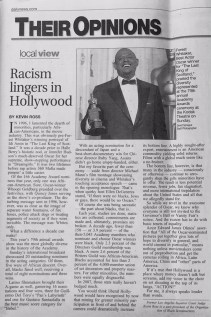
But my favorite part of the ceremony – aside from director Michael Mann’s film montage showcasing diversity in cinema and Whitaker’s touching acceptance speech – came in the opening monologue. That’s when quirky host Ellen DeGeneres stated, “If there were no blacks, Jews, or gays, there would be no Oscars.”
Of course she was being sarcastic – the part about blacks, that is.
Each year studies are done, statistics are collected, commitments are made and, ultimately, promises are broken. A decade ago, fewer than 150 – or 3.9 percent – of the then 5,043 Academy members who nominate and choose Oscar winners were black. Only 2.3 percent of the Directors Guild membership was black. A mere 2.6 percent of the Writers Guild was African-American. Blacks accounted for less than 2 percent of the 4000-member union of set decorators and property masters. For other minorities, the numbers were equally disgraceful.
In 2007, those stats really haven’t budged much despite the fact that in the U.S alone, African-Americans make up 25 – 30 percent of the movie going audience. You would think liberal Hollywood would have recognized by now that mining for greater minority participation in front of and behind the camera could dramatically increase its bottom line. A highly sought-after export, entertainment is a commodity yielding solid returns.
Films with a global reach seem like a no-brainer. The bottom line, however, is that many in the industry – consciously or otherwise – continue to arrogantly shun the gifts minorities have to offer. In a self-regulated industry, the result is less potential revenue, fewer jobs, fan stagnation, and more international trepidation about the United States and all that we allegedly stand for.
So while we revel in the splendor of Oscar, we know why everyone is still not invited to the Governor’s Ball or Vanity Fair’s soiree. And the reason has to do with basic tenets of equality.
Actor Edward James Olmos’ assertion that, “All of the Oscar-nominated pictures put together give lots of hope to diversity in general, and world cinema in particular,” means nothing unless moviemakers come out of preproduction and get the cameras rolling in Africa, Latin America, China and “other parts” of America.
If it’s true that Hollywood is a place where money doesn’t talk but screams, add my voice to the choir on set shouting at the top of its lungs, “ACTION!”
For me, it always speaks louder than words.
Former Los Angeles Superior Court Judge Kevin Ross is a past president of the Organization of Black Screenwriters.
SOURCE – H/T to John Hope Bryant
Why Oscar’s Not Ready for Its Closeup: A few figureheads don’t make up for the dearth of minorities in entertainment.
 The entertainment industry is one of America’s and California’s top exports. The Hollywood sign draws millions of tourism dollars to our local economy, not to mention the thousands who come here in search of fortune and fame.
Yet only one of the 166 nominees at Monday’s Academy Awards is African American. Fewer than 200–or 3.9%–of the 5,043 academy members who nominate and choose Oscar winners are black. Only 2.3% of the Directors Guild membership is black. A mere 2.6% of the Writers Guild is African American. Blacks account for less than 2% of the 4,000-member union of set decorators and property masters. For other minorities, the numbers are equally disgraceful.
Those who collectively make up the entertainment industry are engaging in economic apartheid. Each year, studies are done, statistics are collected, commitments are made to diversify and ultimately, promises are broken. Latinos are fighting to get material “green-lighted.” Asians, Native Americans and others have similar gripes. But what’s particularly interesting about the African American experience is that film and to a lesser extent television have become our last bastions of injustice.
The playing field is most level in sports. While team or franchise ownership still eludes African Americans, talent is rewarded and compensated. Who would dare say to Deion Sanders that he doesn’t run or hit “black enough?” How could you justify adding a white player to an Olympic basketball team simply because the representation is “too black?” Whether it’s Mike Tyson or Michael Jordan, athletes are afforded the opportunity to get paid based on objective standards of performance. The result: increased revenues, more jobs, fan participation and an international fascination with American culture.
African Americans also are some the biggest names in the music industry: Michael and Janet Jackson, Whitney Houston, Seal, TLC, Boyz II Men. Any commercial soundtrack worth its vinyl inevitably will showcase classic Motown tunes, love songs by Babyface or hiphop and rap. The result: increased revenue, more jobs, fan admiration and an international preoccupation with American culture.

Academy of Motion Picture Arts and Sciences Oscar Nominees
In the business of show and tell, however, the game being played is still hide and seek. It’s no wonder that publications like Newsweek, Jet, Vanity Fair and People are starting to draw attention to the movie industry’s dirty little secret. Perhaps with all the talk about dismantling affirmative action, people are beginning to realize the lack of action in this multibillion-dollar industry. The subjective standards of talent, product and commercialism have in fact become smokescreens for power brokers who have no intention of creating true diversity in a self-regulated industry. The result: less revenue, fewer jobs, fan stagnation and international trepidation about American culture.
Instead of feeling smug about Whoopi Goldberg and Quincy Jones having big roles in the Academy Awards program, the issue of discrimination based on race should make everyone feel uncomfortable. And while Jesse Jackson’s involvement and method of drawing attention to this embarrassment can be debated, the message is as clear as the image of separate water fountains, fire hoses, police attack dogs or treating a segment of society as if it is invisible. The message is: whites only.
This isn’t about a guilt trip. With emerging superstars and savvy professionals, African Americans are beginning to knock down these barriers, establish a niche and create their own events such as the NAACP Image Awards. With Latinos recently hosting their own successful awards show as well, we are seeing groups thrive not because of the industry, but in spite of it.
But the questions remain. Can Hollywood, on its own, learn some basic tenets of equity without government regulation? Can deal makers ever be taught to appreciate the gifts being offered by minorities? Can we work collectively and find strength in our differences?
It’s time every facet of the industry answers these questions. Real opportunities for everyone, regardless of race, must be the vision for the future. While we revel in the splendor of Oscar, we know that everyone is not invited to the party. Fairness demands that Hollywood come out of preproduction and start this camera rolling.
Kevin Ross is a Los Angeles deputy district attorney and former president of the Organization of Black Screenwriters.
SOURCE – H/T to the Los Angeles Times


 iambossross